
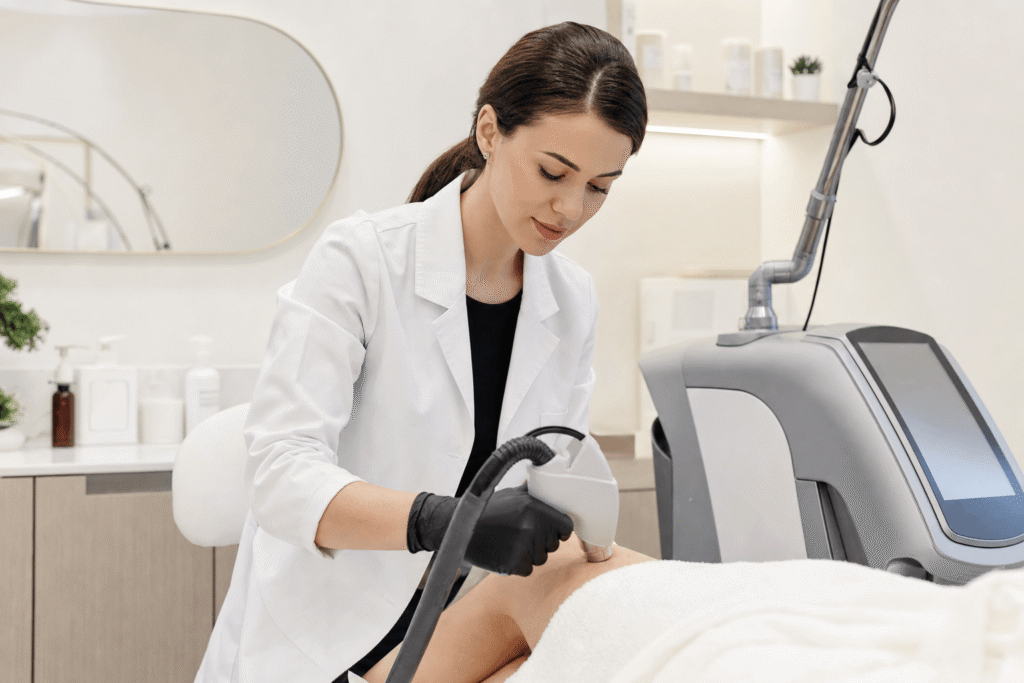
If you’re considering laser hair removal, you’re probably wondering how long those smooth, hair-free results will actually last. The question of longevity is one of the most common concerns clients bring to Samar Skin Care Clinic in North York, and for good reason. You’re investing time and money into a treatment, so understanding how long does laser hair removal last is crucial for setting realistic expectations and planning your treatment timeline.
Laser hair removal delivers permanent hair reduction, not complete removal. Most people enjoy 80-95% reduction that lasts for years after completing their initial treatment series. Some areas stay virtually hair-free for decades, while others may need occasional maintenance sessions every 1-3 years. Results depend on your hair color, skin tone, hormonal factors, and the body area treated.
This guide breaks down everything affecting how long your results will last, from the science of hair growth cycles to the real-world factors that determine whether you’ll need touch-ups. You’ll learn what to expect at different stages post-treatment, why some people need more maintenance than others, and how to maximize the longevity of your results.
Quick Answer
Laser hair removal typically lasts several years to decades with 80-95% permanent reduction after 6-8 sessions. Most clients need maintenance treatments every 1-3 years to address occasional regrowth, especially in hormone-sensitive areas like the face and bikini line.
How Long Does Laser Hair Removal Last? The Complete Answer
The straightforward answer: laser hair removal results last indefinitely for most treated hair follicles. But that’s not the whole story.
When performed correctly with appropriate laser settings for your skin type, laser hair removal destroys targeted follicles permanently. Those specific follicles cannot regenerate and produce new hair. This is why the FDA classifies laser hair removal as a method of permanent hair reduction rather than temporary hair removal like waxing or shaving.
However, your body contains both active and dormant hair follicles at any given time. Laser treatments can only affect follicles that are actively growing during your session. Dormant follicles that activate months or years later will produce new hair growth. This is why you need multiple sessions initially and why some maintenance is typical long-term.
At Samar Skin Care Clinic, clients who complete their full treatment series typically see results that last 5-10 years or more on most body areas. The longevity breaks down differently by body area. Legs, arms, and back typically show the most durable results, with many clients going 7-10 years before noticing any significant regrowth. Hormonal areas like the face, bikini line, and underarms may require maintenance sessions every 1-3 years.
Key Takeaways
- Expect 80-95% permanent reduction lasting years after completing initial treatment series
- Plan for maintenance sessions every 1-3 years in hormone-sensitive areas
- Choose body areas like legs and arms for most durable results
- Verify your provider customizes laser settings for your specific skin type
- Budget for occasional touch-ups rather than ongoing monthly hair removal costs
Understanding Permanent Hair Reduction vs. Permanent Removal
The distinction between permanent hair reduction and permanent removal matters when setting realistic expectations about how long your results will last.
Permanent hair removal means every single hair is gone forever. No method currently achieves this across an entire treatment area. Even electrolysis, which treats individual follicles, cannot guarantee 100% removal because new follicles can develop due to hormonal changes.
Permanent hair reduction, the FDA-approved classification for laser treatments, means a significant, long-lasting decrease in the number of hairs after a series of treatments. In practical terms, this translates to 80-95% fewer hairs in the treated area after completing your sessions.
Is laser hair removal permanent? The answer depends on what you mean by permanent. The follicles successfully treated during the anagen phase are permanently disabled. But you’ll likely see some regrowth over time from follicles that were dormant during treatment or from new follicle activation triggered by hormonal shifts.
This regrowth is typically much finer, lighter, and sparser than your original hair. Many clients describe it as barely noticeable peach fuzz rather than the coarse, dark hair they started with.
How the Hair Growth Cycle Affects Treatment Longevity
Your hair growth cycle is the single biggest factor determining how long laser hair removal lasts and why multiple sessions are necessary.
Hair grows in three distinct phases: anagen (active growth), catagen (transition), and telogen (resting). Laser treatment only works during the anagen phase when the hair shaft is connected to the follicle and contains enough melanin to absorb laser energy effectively.
Here’s the challenge: only 20-30% of your body hair is in anagen phase at any given time. The remaining 70-80% is resting or transitioning. This means a single laser session, no matter how perfectly executed, can only affect a fraction of your total follicles.
After your treatment session, the hair in anagen phase will shed within 1-3 weeks as the damaged follicles release their shafts. But the follicles in catagen and telogen phase remain completely unaffected. As these follicles transition into anagen over the following weeks and months, you’ll see new growth emerge.
This is why session timing matters so much for long-term results. Spacing treatments 4-8 weeks apart allows you to catch each new wave of follicles as they enter anagen. Complete this cycle enough times, and you’ll have treated the vast majority of follicles in the area. Understanding optimal timing between sessions ensures you maximize the percentage of follicles permanently disabled.
Ready to get started?
Book a consultation with Samar to discuss your skin concerns and find the right treatment plan for you.
Factors That Determine How Long Your Results Will Last
Not everyone experiences the same longevity from laser hair removal. Several biological and treatment factors influence how long your smooth results persist.
Hair Color, Skin Tone, and Melanin Levels
Laser hair removal works by targeting melanin, the pigment in your hair. The greater the contrast between your hair color and skin tone, the more effectively the laser can target follicles without affecting surrounding skin.
Dark, coarse hair on light skin responds best and produces the most durable results. The high melanin concentration in the hair shaft absorbs laser energy efficiently, while the low melanin in the surrounding skin remains unaffected. These clients often achieve 90-95% reduction that lasts a decade or more.
Light, fine, or gray hair contains minimal melanin and responds poorly to standard laser wavelengths. You may need significantly more sessions to achieve 70-80% reduction, and results may not last as long.
Darker skin tones require careful wavelength selection and parameter adjustment. When treated with appropriate technology like Nd:YAG lasers, darker skin tones achieve comparable reduction rates and longevity.
Body Area and Hormonal Influences
Where you’re treating has a massive impact on how long results last. Body areas fall into two categories: hormonally stable and hormonally sensitive.
Hormonally stable areas include legs, arms, back, and chest. These regions show the most durable results because follicle activity remains relatively consistent throughout your life. Most clients see results lasting 7-10+ years with minimal maintenance once they complete their initial series.
Hormonally sensitive areas include face, neck, bikini line, and underarms. These zones respond strongly to androgens and other hormones that fluctuate throughout your life. Even after successful treatment, hormonal shifts can reactivate dormant follicles or stimulate new follicle development.
Women with polycystic ovary syndrome (PCOS), thyroid conditions, or hormonal imbalances typically need more frequent maintenance in these areas. Pregnancy, menopause, and certain medications can also trigger new growth years after treatment.
When treating hormonal areas, Samar recommends spacing your final 1-2 sessions further apart, sometimes 12-16 weeks instead of the standard 6-8 weeks. This extended interval helps identify which follicles are truly dormant versus actively cycling, giving you a clearer picture of long-term maintenance needs before concluding your series.
Realistic Timeline: What to Expect at 6 Months, 1 Year, and 5+ Years
Understanding what permanent hair reduction actually looks like at different time points helps you set realistic expectations and plan for long-term maintenance.
Short-Term Results: First 6-12 Months After Treatment
During your treatment series (typically months 0-8), you’ll notice progressive reduction with each session. Hair grows back thinner and slower between appointments. By session 3 or 4, you’re usually seeing 40-60% reduction.
At the 6-month mark, assuming you’ve completed 5-6 sessions, most clients experience 70-85% reduction. The remaining hair is noticeably finer, lighter, and grows much slower than before treatment. Shaving frequency drops from daily or every other day to once weekly or less.
Between months 6-12, you’ll complete your remaining sessions (typically 1-3 more) to address follicles that were dormant during earlier treatments. By month 12, most clients reach their peak reduction of 80-95%, depending on their unique factors.
Mid-Term Results: 1-3 Years Post-Treatment
Years 1-3 typically represent your maintenance-free honeymoon period for most body areas. The 80-95% reduction holds steady. Most clients don’t need any touch-ups during this window unless they’re treating hormonally sensitive zones or experience significant life changes like pregnancy or medication adjustments.
Some clients notice extremely fine regrowth starting around year 2, but it’s usually minimal and much lighter than the original hair. Hormonally stable areas like legs and arms often remain virtually hair-free throughout this entire period.
Long-Term Results: 3-5+ Years Post-Treatment
Around year 3-5, you might notice occasional new growth, typically 5-15% of your original hair density. This regrowth comes from dormant follicles finally activating or from new follicles developing in response to hormonal changes. The hair is usually finer than your original growth but coarser than the peach fuzz that remained after initial treatment.
At this point, most clients schedule a maintenance session or two. These touch-ups typically involve 1-3 treatments spaced 6-8 weeks apart, much like a mini version of your original series. This resets your reduction back to 85-95% for another 2-5 years.
By year 5+, your maintenance pattern becomes clear. Some clients go a decade between touch-ups on areas like legs and arms. Others need annual or biannual maintenance on facial or bikini areas. Either way, the long-term commitment is minimal compared to the ongoing time and cost of temporary methods. Clients who started treatment at Samar Skin Care Clinic 4-5 years ago report that maintenance sessions are their least time-consuming beauty routine. Understanding the permanence question matters when evaluating whether to invest in treatment.
Maintenance Sessions: How Often You’ll Need Touch-Ups
Laser hair removal maintenance sessions are the reality for most clients long-term, but the frequency and extent vary dramatically based on your individual factors.
For hormonally stable areas like legs, arms, and back, maintenance typically occurs every 3-10 years. Many clients go 5+ years before noticing enough regrowth to warrant a touch-up. When they do schedule maintenance, it’s usually just 1-2 sessions that restore their smooth results for several more years.
Hormonally sensitive areas like face, bikini line, and underarms require more frequent attention. Most clients need maintenance every 12-36 months in these zones. The good news: these sessions are quick and catch new growth while it’s still minimal. A single annual session often maintains 85-90% reduction indefinitely.
Life events accelerate maintenance needs. Pregnancy, menopause, starting or stopping birth control, thyroid medication changes, and PCOS flares can all trigger new follicle activation. If you experience any of these, expect to schedule maintenance sooner than your typical interval.
The maintenance pattern stabilizes over time. Your first round of touch-ups after completing your initial series helps identify your personal regrowth pattern. Some clients discover they need annual facial maintenance but their legs stay clear for 8 years. Once you establish this pattern, you can plan and budget accordingly.
Cost-wise, maintenance is dramatically cheaper than ongoing temporary methods. A single maintenance session typically costs $75-150 depending on the area, compared to $30-80 monthly for waxing the same zone. Over a decade, you might spend $300-600 on maintenance versus $3,600-9,600 on continuous waxing.
| Body Area | Typical Maintenance Frequency | Average Touch-Up Sessions Per Decade |
|---|---|---|
| Legs (full) | Every 5-10 years | 1-2 sessions |
| Arms | Every 5-8 years | 1-3 sessions |
| Back/Chest | Every 4-7 years | 2-3 sessions |
| Bikini/Brazilian | Every 1-3 years | 4-8 sessions |
| Underarms | Every 1-3 years | 4-7 sessions |
| Face (women) | Every 1-2 years | 5-10 sessions |
| Face (men) | Every 2-4 years | 3-5 sessions |
At Samar Skin Care Clinic, clients who completed their initial series years ago often email when they notice new growth rather than booking immediately. Samar typically recommends waiting until you see at least 10-15% of your original density return before scheduling maintenance. Treating too early wastes money on follicles that aren’t ready. Waiting until you notice the difference ensures you’re catching new growth during active phases.
Long-Term Value: Laser Hair Removal vs. Lifetime Costs of Waxing and Shaving
When evaluating how long laser hair removal lasts, the financial comparison to temporary methods reveals the true long-term value.
Consider a typical client treating underarms and bikini line, two of the most commonly requested areas. With traditional methods, she spends approximately:
Waxing costs $40-60 per area every 4-6 weeks, totaling $480-720 per area annually. Over 30 years (ages 20-50), that equals $14,400-21,600 per area, or $28,800-43,200 for both areas combined.
Shaving runs $15-25 monthly on razors, shaving cream, and post-shave products, totaling $180-300 annually. Over 30 years: $5,400-9,000. Add the time cost of 10-15 minutes daily, which equals 60-90 hours yearly or 1,800-2,700 hours over 30 years.
Laser hair removal at Samar Skin Care Clinic: Initial series of 6-8 sessions costs approximately $800-1,200 per area. Add maintenance sessions every 2-3 years at $100-150 per area. Over 30 years, total investment: $2,000-3,500 per area, or $4,000-7,000 for both areas combined.
The savings are substantial. Laser hair removal costs 70-85% less than waxing over three decades and saves thousands of hours spent on daily maintenance. Even accounting for more frequent maintenance in hormonal areas, the financial advantage remains overwhelming.
| Hair Removal Method | Annual Cost | 30-Year Cost | Time Investment (30 Years) |
|---|---|---|---|
| Professional Waxing (2 areas) | $960-1,440 | $28,800-43,200 | 240-360 hours |
| At-Home Shaving | $180-300 | $5,400-9,000 | 1,800-2,700 hours |
| Laser Hair Removal + Maintenance | $80-150 (avg) | $4,000-7,000 | 15-30 hours |
The value extends beyond money. Clients report improved confidence, reduced skin irritation from constant shaving, elimination of ingrown hairs, and freedom from planning beach vacations or intimate moments around hair removal schedules. These quality-of-life improvements don’t appear on a balance sheet but matter enormously to most people.
For North York residents, the cost-benefit analysis becomes even more compelling when you factor in Toronto’s climate. Winter months mean bulkier clothing that hides stubble from shaving, but laser hair removal eliminates the need to choose between smooth skin and the daily irritation of shaving dry winter skin. The long-term savings in both money and convenience make laser hair removal one of the highest-value aesthetic investments you can make.
Climate and Seasonal Considerations for North York Clients
Toronto’s climate affects both treatment timing and results longevity in ways worth considering when planning your laser hair removal schedule.
Fall and winter (October through March) are ideal for starting treatment in North York. Lower UV exposure during these months means less risk of complications from sun damage and better treatment outcomes. You can use higher energy settings safely, which improves the percentage of follicles permanently disabled and extends time between future maintenance sessions.
Starting in fall also means you’ll complete most of your initial series before summer, giving you smooth, hair-free skin for beach season. This timing works particularly well for areas like legs, arms, bikini line, and back that see significant sun exposure during Toronto summers.
Winter dryness requires extra skin hydration between sessions. Cold, dry air can make skin more sensitive to laser treatment. Samar recommends using fragrance-free moisturizer twice daily and avoiding hot showers that strip skin oils. Well-hydrated skin tolerates treatment better and heals faster, contributing to better long-term results.
Summer presents challenges for ongoing treatment. You must avoid sun exposure for 2 weeks before and after each session. Tanned skin contains higher melanin levels that compete with hair follicles for laser energy, reducing effectiveness and increasing complication risk. If you must treat during summer, use SPF 30+ daily and avoid outdoor activities that cause tanning.
North York’s distinct seasons actually work in your favor for maintenance planning. Schedule your touch-up sessions during fall or winter when your skin is at its lightest. This timing ensures optimal settings that maximize follicle destruction and extend the time until your next maintenance session. Understanding how laser technology works helps explain why seasonal timing affects both immediate results and long-term maintenance frequency.
Maximizing Results: How to Make Your Treatment Last Longer
While you can’t control your biology, certain practices maximize the longevity of your laser hair removal results and minimize maintenance frequency.
Complete your full initial series without skipping sessions or extending intervals too far. Every session targets a new wave of follicles entering their growth phase. Skipping session 7 because you already look 85% clear means you’re leaving a larger pool of dormant follicles that will activate later and require earlier maintenance.
Avoid sun exposure and maintain consistent sunscreen use in treated areas. UV damage affects melanin distribution in both skin and hair follicles, potentially reducing treatment effectiveness. More importantly, sun exposure between sessions increases complications risk and may force your provider to use lower energy settings.
Don’t wax, pluck, or epilate between laser sessions. These methods remove the hair shaft that the laser needs to target. Shaving is fine because it leaves the follicle intact, but pulling hair out by the root interferes with treatment timing.
Manage hormonal health proactively. If you have PCOS, thyroid issues, or other endocrine conditions, work with your physician to keep hormone levels as stable as possible. Well-managed hormones mean less new follicle activation and longer intervals between maintenance sessions.
Choose a qualified, experienced provider using appropriate technology for your skin type. Treatments performed with inadequate energy settings, wrong wavelengths, or poorly calibrated equipment produce inferior long-term results. At Samar Skin Care Clinic, every treatment is customized to your individual melanin levels and follicle characteristics to ensure maximum longevity.
Frequently Asked Questions
How long does laser hair removal last on average?
Laser hair removal typically lasts several years to indefinitely for most treated follicles. After completing 6-8 initial sessions, most clients maintain 80-95% reduction for 3-5 years before needing maintenance. Hormonally stable areas like legs often last 7-10+ years, while face and bikini areas may need touch-ups every 1-3 years.
Is laser hair removal truly permanent or will hair grow back?
Laser hair removal provides permanent hair reduction, not complete permanent removal. Individual follicles successfully treated are permanently destroyed and cannot regenerate. However, you’ll likely experience some regrowth over time from follicles that were dormant during treatment or from new follicles activated by hormonal changes. This regrowth is typically 5-20% of original density.
How many sessions are needed for long-lasting results?
Most people need 6-8 sessions for optimal long-lasting results, though this varies by body area, hair color, skin tone, and hormonal factors. Sessions are typically spaced 4-8 weeks apart to target different waves of hair as follicles cycle through growth phases. Completing the full series maximizes long-term reduction and extends time between maintenance treatments.
How often do I need maintenance sessions after completing treatment?
Maintenance frequency varies significantly by body area. Hormonally stable areas like legs, arms, and back typically need maintenance every 3-10 years, often just 1-2 sessions. Hormonally sensitive areas like face, underarms, and bikini line usually require touch-ups every 1-3 years. Hormonal changes from pregnancy, menopause, PCOS, or medications can increase maintenance needs.
Can hormonal changes cause hair to grow back after laser hair removal?
Yes, hormonal changes can trigger new hair growth even in successfully treated areas. Pregnancy, menopause, PCOS, thyroid conditions, and starting or stopping hormonal medications can all activate dormant follicles or stimulate new follicle development. This new growth responds well to maintenance sessions, and most people maintain 80-90% reduction long-term even with hormonal fluctuations.
Ready to Start Your Laser Hair Removal Journey?
Understanding how long laser hair removal lasts helps you make an informed decision about investing in permanent hair reduction. With 80-95% reduction lasting years to decades, plus minimal maintenance requirements, the long-term value far exceeds temporary methods like waxing and shaving. Your individual results depend on factors like hair color, skin tone, body area, and hormonal influences, but the convenience and confidence that come with smooth, hair-free skin remain consistent across all clients.
Samar Skin Care Clinic in North York specializes in customized laser hair removal treatments designed for your unique skin type and hair characteristics. Samar uses advanced assessment techniques and precise laser calibration to maximize your results and minimize your long-term maintenance needs. Book a consultation today to discuss your treatment timeline, get realistic expectations for your specific situation, and start your journey toward permanently reduced hair growth. Call (647) 764-8424 or visit us at 5409 Yonge St, Unit 210, North York, ON M2N 5R6.
