
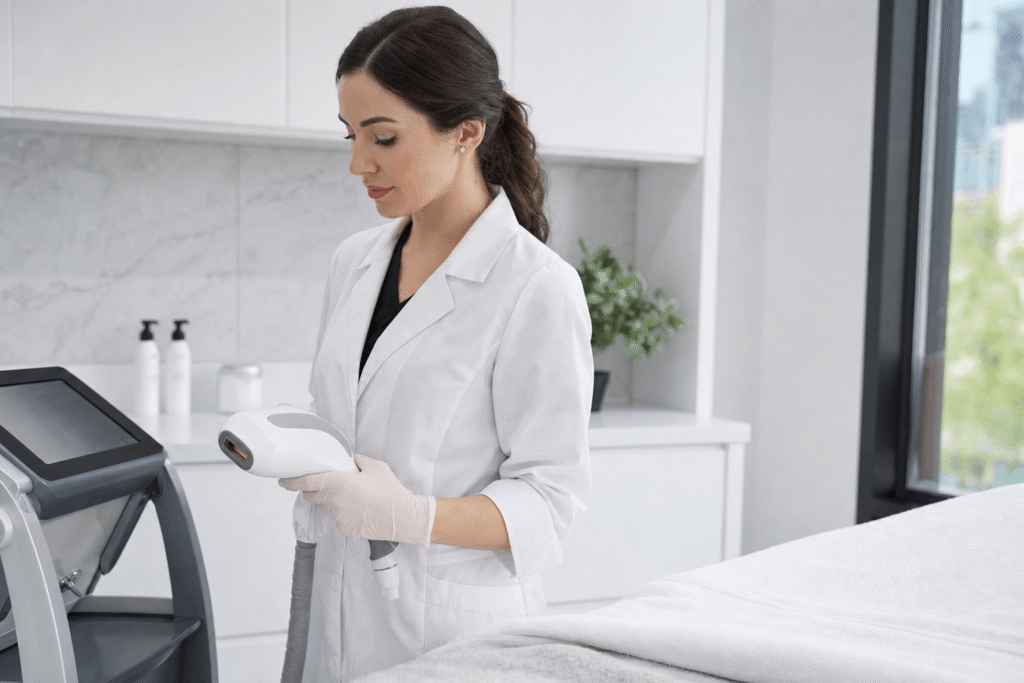
If you’re researching whether at-home laser hair removal devices actually deliver on their promises, you’re asking the right question. These consumer devices flood the market with bold claims about permanent hair removal, but the reality is more nuanced. At-home laser hair removal devices do work for some people under specific conditions, but they’re not universally effective, they’re not truly “laser” in most cases, and they deliver significantly different results compared to professional treatment. This article breaks down the clinical evidence, explains who can expect results, reveals which body areas respond poorly to at-home devices, and shows you exactly when professional treatment becomes necessary.
Quick Answer
At-home devices can reduce hair growth by 30-70% for people with light skin and dark hair, but most use IPL technology rather than true laser, require consistent treatment over 6-12 months, and rarely achieve the permanent reduction possible with professional equipment.
Do At-Home Laser Hair Removal Devices Actually Work? The Evidence
The effectiveness question requires splitting marketing claims from clinical reality. Most consumer devices marketed as “laser” hair removal actually use IPL (Intense Pulsed Light) technology, which is fundamentally different from the medical-grade diode, alexandrite, or Nd:YAG lasers used in professional settings.
Clinical studies show at-home IPL devices can achieve 30-70% hair reduction after 8-12 treatments when used on ideal candidates. That’s not insignificant, but it’s markedly lower than the 85-95% reduction typical with professional laser systems. The catch? These results apply only to people with Fitzpatrick skin types I-III (light to medium skin) and dark, coarse hair.
FDA clearance for these devices uses careful language: “permanent hair reduction,” not “permanent hair removal.” The distinction matters. Reduction means fewer hairs grow back, and those that do are often finer and lighter. Removal implies the follicle is destroyed permanently. Consumer devices rarely achieve true follicle destruction because they operate at lower energy levels (typically 3-5 joules per square centimeter) compared to professional systems (12-40 joules depending on the treatment area and skin type).
At Samar Skin Care Clinic in North York, Samar regularly consults with clients who’ve spent months using at-home devices with disappointing results. The most common scenario? Initial reduction in the easiest areas like lower legs, followed by plateau, especially in hormonal areas like the face, bikini line, and underarms where hair growth is driven by factors beyond what low-energy light can address.
Key Takeaways
- Expect 30-70% reduction maximum with at-home devices versus 85-95% professionally
- Verify your skin and hair color compatibility before purchasing any device
- Budget 6-12 months of biweekly treatments to see meaningful results
- Avoid at-home devices for facial hair if you have hormonal conditions
- Choose professional treatment for darker skin tones above Fitzpatrick type III
- Consider long-term cost analysis before committing to either approach
How At-Home Laser Technology Works: IPL vs True Laser Devices
Understanding the technology gap between consumer and professional devices explains why results differ so dramatically. Most at-home devices use IPL, which emits a broad spectrum of light wavelengths (500-1200 nanometers) rather than a single focused wavelength. Think of it like a flashlight compared to a laser pointer. This broad-spectrum approach means only a portion of the emitted light actually targets melanin in the hair follicle, while the rest disperses into surrounding tissue.
True consumer laser devices (rare and more expensive) use lower-powered diode laser technology, typically emitting at 810 nanometers. This wavelength penetrates deeper than IPL’s scattered light, targeting melanin more precisely. Even these “true laser” consumer devices operate at significantly reduced power compared to professional systems. Where a medical-grade diode laser might deliver 20-30 joules with integrated cooling systems and real-time skin monitoring, consumer lasers cap at 7-12 joules without the sophisticated cooling that makes higher energy tolerable and safe.
The treatment window size also differs dramatically. Consumer devices typically treat 1-3 square centimeters per pulse, while professional handpieces cover 10-15 square centimeters or more, making full-body treatment practical. This is why at-home treatment of large areas like full legs becomes tedious enough that most people abandon treatment before completing the necessary sessions.
Who Can Achieve Results with At-Home Devices? (Skin Tone, Hair Color & Suitability)
The harsh reality: at-home laser hair removal effectiveness is heavily restricted by your natural coloring. These devices work through contrast, they need to “see” dark hair against light skin to function.
The Fitzpatrick skin type scale (I-VI) categorizes skin tones based on melanin content and sun sensitivity. At-home devices work best on types I-III: very fair to light brown skin. Type IV (moderate brown) sits in a gray zone where results become unpredictable and skin injury risk increases. Types V-VI (dark brown to deeply pigmented skin) should avoid at-home devices entirely due to high risk of burns, hyperpigmentation, and paradoxical hair stimulation.
Hair color requirements are equally strict. Black and dark brown hair contains enough melanin to absorb light energy effectively. Medium brown hair works inconsistently. Light brown, blonde, red, and gray hair contain insufficient melanin for IPL or laser technology to target, regardless of device quality.
| Skin Type | Hair Color | At-Home Device Suitability | Expected Results |
|---|---|---|---|
| Fitzpatrick I-II (Very Fair) | Black/Dark Brown | Ideal Candidate | 50-70% reduction possible |
| Fitzpatrick III (Light Brown) | Dark Brown/Medium Brown | Good Candidate | 30-50% reduction typical |
| Fitzpatrick IV (Moderate Brown) | Dark Brown | Marginal Candidate | Unpredictable, higher risk |
| Fitzpatrick V-VI (Dark Brown to Deep) | Any Color | Not Suitable | High injury risk, minimal results |
| Any Skin Type | Blonde/Red/Gray/White | Not Suitable | Insufficient melanin to target |
Certain medical conditions and medications also disqualify at-home device use. Active skin infections, keloid scarring history, photosensitizing medications (tetracycline antibiotics, certain acne treatments, some blood pressure medications), and hormonal disorders like PCOS require professional evaluation before any light-based hair removal.
Ready to get started?
Book a consultation with Samar to discuss your skin concerns and find the right treatment plan for you.
Realistic Expectations: Treatment Timeline, Permanence & Results by Body Area
Setting accurate expectations separates satisfied users from disappointed ones. At-home devices require significant time investment, and results vary dramatically by treatment location.
Most manufacturers recommend 8-12 initial treatments spaced two weeks apart, followed by monthly maintenance indefinitely. That’s 4-6 months before you can properly assess results, and you’ll never truly stop treating. Compare this to professional laser hair removal timelines of 6-8 sessions over 8-12 months with minimal maintenance afterward.
Hair grows in three phases: anagen (active growth), catagen (transition), and telogen (resting). Only anagen-phase hairs contain enough melanin connectivity to the follicle for light energy to cause damage. At any given time, only 20-30% of body hair is in anagen phase, which is why multiple treatments are necessary regardless of device type.
Which Body Areas Respond Best to At-Home Treatment
Lower legs and forearms consistently show the best results with at-home devices. These areas have relatively uniform hair growth, less hormonal influence, and larger treatment surfaces that make the time investment more tolerable. Users report 40-60% reduction in these areas after completing full treatment protocols.
Areas That Consistently Underperform with Home Devices
Facial hair, particularly for women dealing with hormonal growth on the upper lip, chin, and jawline, rarely responds well to at-home devices. The hair density, hormonal drivers, and sensitivity of facial skin create a perfect storm of challenges. Many women who’ve achieved good results on body hair see virtually no improvement on facial hair with the same device.
The Brazilian area and underarms present unique challenges. The hair is coarser and more deeply rooted, requiring higher energy levels to reach the follicle. The skin is more pigmented in these areas for most people, reducing the contrast needed for safe, effective treatment. And the awkward angles make consistent, thorough coverage nearly impossible.
Back and chest hair on men rarely sees significant improvement with at-home devices. The coverage area is too large, the hair too coarse, and the inability to treat your own back without assistance makes consistent treatment impractical.
At-Home vs Professional Laser Hair Removal: A Direct Comparison
The comparison between at-home and professional laser hair removal extends beyond just effectiveness. Cost, time investment, safety, and long-term satisfaction all factor into the decision.
| Factor | At-Home Devices | Professional Treatment |
|---|---|---|
| Technology | IPL or low-power diode (3-6 joules) | Medical-grade diode, alexandrite, or Nd:YAG (12-40 joules) |
| Treatment Sessions | 8-12 initial, then monthly maintenance indefinitely | 6-8 sessions, minimal maintenance |
| Time Per Session | 20-90 minutes depending on area | 10-45 minutes for same areas |
| Expected Reduction | 30-70% for ideal candidates | 85-95% typical results |
| Upfront Cost | $200-$600 device purchase | $1,200-$3,500 for treatment packages |
| Skin Type Range | Fitzpatrick I-III only | I-VI with appropriate laser selection |
| Hair Color Range | Black to medium brown only | Black to light brown (Nd:YAG can treat some finer hair) |
| Expertise Required | Self-administered following manual | Licensed medical aesthetician or physician |
| Pain Management | Basic cooling gels or cold tips | Integrated cryogen spray, cooled sapphire tips, forced-air cooling |
| Results Permanence | Temporary reduction, ongoing maintenance required | Permanent reduction, minimal touch-ups needed |
The technology gap creates a cascade of differences. Professional systems like the ones used at Samar Skin Care Clinic deliver precise wavelengths at higher energy with integrated cooling systems. This combination allows treatment of all skin types when the appropriate laser is selected (alexandrite for lighter skin, Nd:YAG for darker skin, diode for medium tones). Safety protocols differ significantly. Professional treatment includes pre-treatment skin assessment, patch testing for new clients, and real-time adjustment of settings based on skin response. At-home devices rely on built-in skin sensors that provide basic safety cutoffs but can’t replicate the nuanced assessment a trained practitioner provides. Pain levels vary between the approaches, but not always in the direction people expect. While you might assume professional lasers hurt more due to higher power, the opposite is often true. Professional systems include sophisticated cooling mechanisms that make treatments surprisingly comfortable. At-home devices lack advanced cooling, and users often report significant discomfort, especially on sensitive areas. The difference in pain levels during laser hair removal relates more to cooling technology than power output.
Safety Considerations and When At-Home Devices Fail
At-home devices carry FDA clearance for consumer use, which means they include safety features limiting their power output. But “safe for home use” doesn’t mean “risk-free.” Understanding potential complications helps you use these devices more safely and recognize when professional intervention becomes necessary.
Mild redness and slight swelling immediately after treatment are normal responses and typically resolve within 2-4 hours. Burns and blistering occur when users ignore skin tone warnings or treat recently tanned skin. Hyperpigmentation (darkened patches) and hypopigmentation (lightened patches) represent more serious complications that can persist for months. Eye injury from accidental exposure to the light pulse is a real risk, especially when treating facial areas.
When At-Home Devices Fail: Specific Scenarios Requiring Professional Treatment
Hormonal conditions like polycystic ovary syndrome (PCOS) drive hair growth from internal signals that override the effects of hair removal devices. Women with PCOS often experience rapid regrowth on the face, chin, neck, and abdomen regardless of how consistently they use at-home devices. The condition creates a continuous supply of anagen-phase hairs, meaning treated follicles are quickly replaced by new growth stimulated by elevated androgen levels.
Professional treatment can still help manage these symptoms, though it can’t address the underlying hormonal cause. Samar regularly works with clients managing PCOS-related facial hair, coordinating treatment timing with their endocrinologist’s care plan and adjusting laser protocols to account for the rapid regrowth cycles these conditions create. The higher energy levels of professional lasers can achieve better temporary reduction, though maintenance sessions remain necessary as long as the hormonal imbalance persists.
Medication-induced hair growth from corticosteroids, certain blood pressure medications, immunosuppressants, or hormone treatments similarly renders at-home devices ineffective. Thyroid disorders affect hair growth patterns throughout the body, and at-home devices show poor results until thyroid function is medically stabilized. Scarring from previous at-home device misuse requires professional assessment before any further treatment.
Lack of results after completing a full treatment protocol (12+ sessions over 6 months) suggests your hair type, skin tone, or hormonal profile isn’t suited to at-home devices. Continuing to treat the same areas with the same approach rarely produces better outcomes. This is the point where most people should evaluate professional laser technology as an alternative.
How to Use At-Home Devices Safely: Preparation, Treatment & Aftercare
If you’ve decided to try at-home laser hair removal after understanding the limitations, proper technique maximizes your chances of success and minimizes complication risk.
Preparation starts 4-6 weeks before your first treatment. Avoid waxing, threading, or epilating during this period. These methods remove the hair root, eliminating the melanin target needed for laser energy to work. Shaving is fine and actually preferred. Shave the treatment area 12-24 hours before each session. The ideal hair length is 1-2 millimeters: short enough that the laser energy travels down the hair shaft to the follicle rather than burning off surface hair, but visible enough to confirm thorough coverage.
Start with the lowest energy setting for your first session, regardless of your skin tone. Assess your skin’s response over the next 24 hours before increasing power. Treat in a systematic pattern to ensure complete coverage without overlap. Apply the device perpendicular to the skin surface with firm, even contact.
Immediate aftercare includes applying a bland moisturizer or aloe vera gel if skin feels warm or looks pink. Avoid hot showers, vigorous exercise, or anything that increases skin temperature for 24 hours post-treatment. Skip active skincare ingredients (retinoids, acids, vitamin C) for 2-3 days to prevent irritation on laser-exposed skin. Sun protection becomes critical after treatment. Apply broad-spectrum SPF 30 or higher daily, and avoid direct sun exposure when possible.
Long-Term Cost Analysis: At-Home vs Professional Investment
The purchase price of an at-home device looks appealing compared to professional treatment packages until you calculate the complete cost over time and factor in the breakeven point between the two approaches.
Quality at-home IPL devices range from $200-$400 for basic models to $500-$600 for advanced units. Professional laser hair removal packages vary by treatment area and clinic location. In the North York and Toronto market, expect $300-$500 per session for small areas (underarms, bikini), $400-$700 for medium areas (Brazilian, lower legs, full arms), and $800-$1,200 for large areas (full legs, back, chest). Most clinics offer 6-8 session packages at 15-25% discount.
| Treatment Scenario | At-Home Year 1 Cost | At-Home 5-Year Total | Professional Total Cost | Breakeven Point |
|---|---|---|---|---|
| Underarms Only | $400 device + 15 hours time | $450 (device + maintenance cartridges) + 25 hours total | $1,400 (6-session package) | Never breaks even in pure dollars; at-home saves $950 if protocol completed |
| Brazilian + Underarms | $450 device + 25 hours time | $500 (device + maintenance) + 40 hours total | $2,200 (6-session package both areas) | At-home saves $1,700 over 5 years if protocol completed consistently |
| Full Legs + Brazilian + Underarms | $500 device + 60 hours Year 1 | $600 (device + cartridges) + 100+ hours total | $3,800 (6-session package all areas) | Theoretical savings of $3,200, but 65% abandon treatment by month 6, wasting device cost |
| Full Body (6+ areas) | $550 device + 120+ hours Year 1 | $650 + 180+ hours over 5 years | $6,500 (comprehensive package) | At-home theoretically breaks even at year 1, but 75% abandon within 4 months due to time burden |
The hidden cost in at-home treatment is time. A full-leg treatment with a consumer device takes 45-60 minutes, compared to 20-30 minutes professionally. Multiply that by 12+ sessions in year one, plus ongoing maintenance, and you’re investing 20-40 hours for legs alone. When you calculate time at even minimum wage rates, the “savings” of at-home devices evaporate quickly for anything beyond small treatment areas.
Treatment abandonment rates complicate the cost analysis further. Industry estimates suggest 40-60% of at-home device purchasers stop consistent treatment within 6 months, often after completing only 4-6 sessions. At that point, they’ve spent the device cost without achieving meaningful results, and subsequently pay for professional treatment anyway, effectively doubling their total investment.
The breakeven calculation shifts dramatically based on three factors: how many areas you’re treating, whether you actually complete the full treatment protocol consistently, and how you value your time. For someone committed to treating only underarms who has ideal skin and hair coloring, at-home devices break even around month 8-10 compared to professional treatment costs. For someone wanting Brazilian plus underarms, the breakeven point arrives around month 12-14. But for multiple large areas, most people abandon treatment before reaching any breakeven point, making the at-home device a sunk cost.
The value equation tips toward professional treatment when you factor in superior results. Professional treatment achieves 85-95% reduction in 6-8 sessions versus at-home’s 30-70% reduction requiring indefinite maintenance. If you calculate cost per percentage point of hair reduction achieved, professional treatment often delivers better value even with higher upfront costs.
Transitioning from At-Home to Professional Treatment
Many people who start with at-home devices eventually seek professional treatment, either because results plateau or because they realize the time investment isn’t sustainable. Understanding how to leverage your at-home experience during this transition helps set realistic expectations and optimize your professional treatment plan.
Your at-home treatment history provides valuable information for your aesthetician that directly affects how she calibrates laser settings and structures your treatment plan. When you transition from at-home to professional treatment, your provider needs specific information: which device you used and at what energy settings, how many sessions you completed, which body areas you treated, what results you achieved, and whether you experienced any complications like burns, hyperpigmentation, or paradoxical hair growth.
Areas that responded well to at-home treatment may require fewer professional sessions to achieve complete clearance because some follicle damage has already occurred. The professional laser can build on this foundation rather than starting from zero. Conversely, areas that showed no response to home treatment often indicate either unsuitable hair characteristics (too fine, too light) or hormonal factors that even professional treatment will struggle to address, though the higher power of medical lasers can sometimes overcome what consumer devices couldn’t.
At Samar Skin Care Clinic, Samar specifically asks clients about previous at-home device use during consultations because it affects how she approaches treatment. She needs to see the current state of your hair growth patterns after home treatment rather than make assumptions based on typical hair density. If you experienced complications with at-home devices like hyperpigmentation or burns, she adjusts professional laser settings to account for your skin’s demonstrated sensitivity, typically starting at lower fluence and gradually increasing as your skin tolerance is confirmed.
The timing of your transition matters for accurate assessment. Schedule your professional consultation 4-6 weeks after your last at-home treatment session. This allows the hair growth cycle to normalize and gives your aesthetician a clearer picture of your natural hair density and growth patterns rather than the mixed signals created by inconsistent home treatment. If you’ve been maintaining with monthly home sessions, stop these treatments 6 weeks before your professional consultation so your provider can assess true regrowth patterns.
Bring your at-home device (or photos of the model and settings display) to your professional consultation. Samar can better understand the energy levels and wavelengths your skin has been exposed to, which helps her select optimal starting parameters for professional treatment and avoid over-treating areas that may be more sensitive than typical.
Clients transitioning from at-home devices often appreciate the dramatic difference in treatment efficiency at professional clinics. What took them an hour at home takes 15-20 minutes professionally, and they typically see noticeably better reduction after just 2-3 professional sessions than they achieved with 10-12 home sessions. This efficiency difference often justifies the higher per-session cost when people calculate total time investment and actual results achieved. One advantage of starting with at-home treatment before going professional: you’ve already confirmed you can tolerate the sensation of light-based hair removal, you understand the treatment process and commitment required, and you’ve identified which body areas matter most to you.
Frequently Asked Questions
Do at-home laser hair removal devices actually work for permanent hair reduction?
At-home devices can achieve 30-70% hair reduction for people with light skin (Fitzpatrick types I-III) and dark hair after 8-12 treatments, but this is permanent reduction, not complete removal. Results require ongoing maintenance treatments monthly, and effectiveness is significantly lower than professional laser systems which typically achieve 85-95% reduction. The devices work by damaging hair follicles, but their lower energy output (3-6 joules) means they rarely destroy follicles completely.
Is at-home laser hair removal safe for all skin tones?
No, at-home devices are only safe for light to medium skin tones (Fitzpatrick types I-III). People with Fitzpatrick type IV skin face unpredictable results and higher risk of burns or pigmentation changes, while types V-VI should avoid at-home devices entirely. Professional treatment offers safe options for all skin tones through laser selection (Nd:YAG for darker skin) and expert calibration.
Does at-home laser hair removal hurt compared to professional treatment?
At-home devices often cause more discomfort than professional treatment despite using lower power, because they lack the sophisticated cooling systems found in medical-grade lasers. Consumer devices may include basic cooling gels or cold tips, but professional systems use integrated cryogen spray, cooled sapphire contact tips, or forced-air cooling that makes higher-energy treatments surprisingly comfortable.
How long does it take to see results from at-home laser hair removal?
Most users notice initial hair reduction after 4-6 biweekly treatments (2-3 months), with maximum results appearing after completing 10-12 sessions over 5-6 months. However, results vary significantly by body area, with lower legs and forearms responding fastest while facial hair, bikini area, and underarms often show minimal change even after full treatment protocols.
What is the real cost difference between at-home devices and professional laser hair removal over time?
At-home devices cost $200-$600 upfront but require indefinite monthly maintenance and significant time investment (20-100+ hours over 5 years depending on treatment areas). Professional treatment costs $1,200-$3,500 for complete packages with minimal touch-ups needed long-term. For small areas like underarms alone, at-home devices save $950-$1,200 over five years if you complete the full protocol. For multiple areas, the breakeven point becomes theoretical because 40-60% of users abandon treatment within six months, wasting the device cost before achieving results.
Making Your Decision: At-Home or Professional Treatment
The question of whether at-home laser hair removal devices work has a nuanced answer: they work for some people, on some body areas, under specific conditions, but with significantly lower effectiveness than professional treatment. If you have very light skin, dark coarse hair, realistic expectations for 30-50% reduction rather than complete removal, patience for 6-12 months of consistent biweekly treatments, and you’re focusing on easy areas like lower legs or forearms, at-home devices can deliver reasonable results for a fraction of professional treatment costs.
But if any of these conditions don’t apply, if you’re treating multiple areas, if you have hormonal hair growth, or if you want comprehensive reduction approaching permanent results, professional laser hair removal represents the more effective investment. The technology gap between consumer IPL devices and medical-grade laser systems isn’t something you can overcome through more sessions or higher power settings on home equipment.
Samar Skin Care Clinic specializes in helping North York clients navigate exactly these decisions. Samar, a Licensed Medical Aesthetician who graduated from CNTAA in 2020 and holds more than 10 specialized certifications in laser treatments and advanced aesthetics, provides honest assessments during consultations. She’s worked with hundreds of clients who attempted at-home treatment first, and she understands both the appeal of that approach and its limitations. Whether you’re considering your first laser hair removal treatment or you’ve been struggling with an at-home device that isn’t delivering results, a professional evaluation provides clarity.
Ready to explore professional laser hair removal at Samar Skin Care Clinic? Located at 5409 Yonge St, Unit 210, North York, ON M2N 5R6, the clinic offers comprehensive consultations where Samar assesses your skin type, hair characteristics, and treatment goals to develop a customized plan. Call (647) 764-8424 or schedule your consultation online to discuss which approach will deliver the results you’re looking for.
