
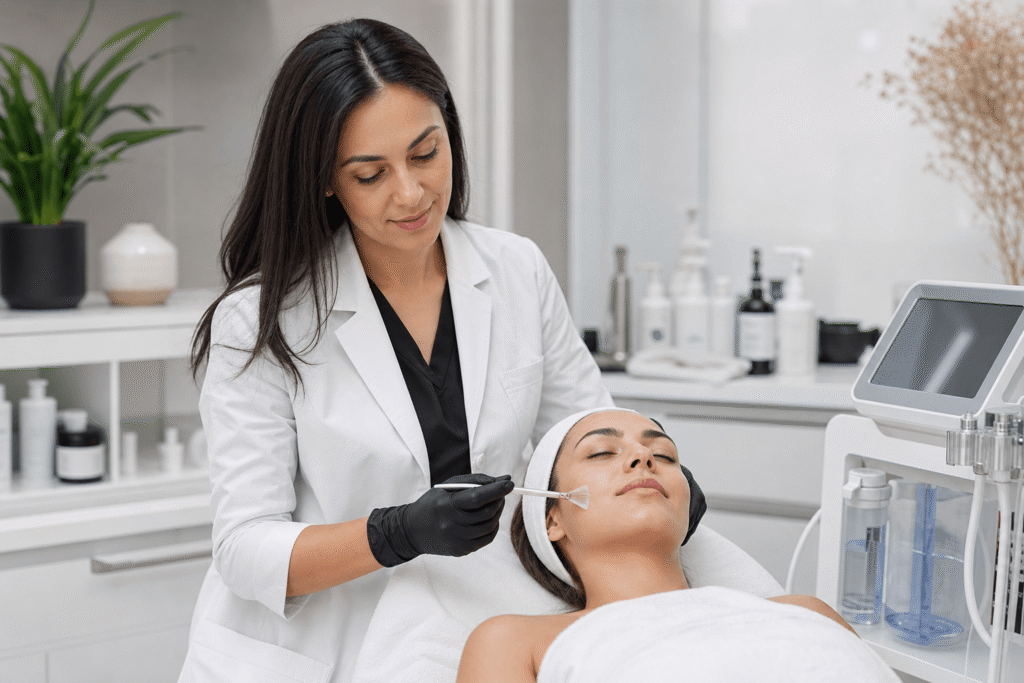
A chemical peel is a controlled skin-resurfacing procedure that uses acid solutions to remove damaged outer layers of skin, revealing smoother, clearer, and more even-toned skin underneath. This professional treatment addresses concerns ranging from fine lines and acne scars to hyperpigmentation and sun damage. Understanding what a chemical peel actually does, the different types available, and what to expect during treatment and recovery helps you determine whether this procedure aligns with your skin goals.
This guide covers how chemical peels work at a cellular level, the specific skin concerns they treat most effectively, the differences between light, medium, and deep peels, what happens during the procedure itself, recovery timelines by peel depth, and how to choose the right type for your needs. You’ll also learn how chemical peels compare to alternative treatments like microneedling and laser resurfacing.
Quick Answer
A chemical peel is a skin treatment that applies acid solutions to exfoliate damaged skin layers, stimulating cell turnover and collagen production to improve texture, tone, and clarity with varying depths and recovery times.
What Is a Chemical Peel and How Does It Work?
Chemical peels work through controlled chemical exfoliation. An acid solution is applied to your skin, causing the bonds between dead skin cells to break down. The damaged outer layers peel away over days or weeks, depending on the peel depth, while your body accelerates the production of new skin cells and collagen fibers beneath.
The depth of penetration determines results and recovery time. Light peels affect only the epidermis (outermost layer), medium peels reach the upper dermis, and deep peels penetrate the mid-dermal layer. Each depth uses different acid concentrations and formulations.
The most common acids include glycolic acid (derived from sugar cane), salicylic acid (oil-soluble, ideal for acne-prone skin), trichloroacetic acid or TCA (medium to deep peels), lactic acid (gentle, hydrating), and phenol (the deepest peel option). Each acid molecule size and pH level determines how deeply it penetrates.
When the acid solution contacts your skin, it lowers the pH, disrupting the protein bonds in the stratum corneum. This triggers an inflammatory response that your body interprets as controlled injury. The healing process brings fresh skin cells to the surface while stimulating fibroblasts to produce new collagen and elastin in the dermis.
At Samar Skin Care Clinic in North York, consultations begin with analyzing your Fitzpatrick skin type and specific concerns before selecting acid type and concentration. Samar evaluates factors like active acne, recent sun exposure, and medication use, all of which affect peel selection and safety.
Key Takeaways
- Choose peel depth based on your specific concern and downtime tolerance.
- Expect visible peeling for 3-14 days depending on peel strength used.
- Avoid chemical peels if you’ve used retinoids within 48 hours prior.
- Plan treatments for fall or winter in Toronto to minimize sun exposure.
- Verify your provider’s credentials before booking any chemical peel treatment.
What Skin Concerns Can Chemical Peels Treat?
Chemical peels address multiple skin concerns with varying degrees of effectiveness depending on peel depth. Fine lines and wrinkles respond well to medium and deep peels, which stimulate significant collagen remodeling. Light peels offer subtle improvement in texture and mild wrinkles.
Hyperpigmentation, including melasma, post-inflammatory hyperpigmentation, and sun spots, sees improvement with glycolic acid and TCA peels. These conditions require multiple treatment sessions and strict sun protection. Jessner’s peel, which combines resorcinol, lactic acid, and salicyric acid, works particularly well for uneven pigmentation.
Acne and acne scarring benefit from salicylic acid peels, which penetrate oil-filled pores. Atrophic scars (depressed scarring) respond better to medium-depth TCA peels that stimulate collagen production in the dermis. Active breakouts may improve with light peels, though inflamed cystic acne requires medical treatment first. Photoaging from cumulative sun damage, including rough texture, sallowness, and freckling, improves with medium peels.
Types of Chemical Peels: Light, Medium, and Deep
Understanding peel classifications helps you set realistic expectations. The three main categories differ in penetration depth, active ingredients, results, and recovery requirements.
Light (Superficial) Peels
Light peels penetrate only the epidermis using alpha hydroxy acids (AHAs) like glycolic acid or beta hydroxy acids (BHAs) like salicylic acid. Concentrations typically range from 20% to 35% for glycolic acid and 20% to 30% for salicylic acid. These peels require minimal downtime, usually just light flaking for 2-4 days. Results include brighter tone, smoother texture, and reduced appearance of superficial discoloration. Most people need a series of 4-6 light peels spaced 2-4 weeks apart for visible improvement.
Medium and Deep Peels
Medium peels use trichloroacetic acid (TCA) in concentrations of 25% to 35%, reaching the upper dermis. They treat moderate wrinkles, acne scars, and stubborn pigmentation. Recovery takes 7-14 days with significant peeling and redness. TCA peels create a frost or white appearance on the skin during application, indicating protein coagulation.
Deep peels use phenol solutions and penetrate the mid-dermis. These dramatic treatments address severe photoaging, deep wrinkles, and pronounced scarring. Recovery extends 14-21 days with significant swelling, oozing, and crusting. Phenol peels carry more risks, including cardiac concerns and permanent skin lightening. They require medical supervision and often sedation.
For North York clients at Samar Skin Care Clinic, TCA peels represent the most commonly recommended medium-depth option. Samar adjusts TCA concentration and layering technique based on each client’s Fitzpatrick type, a critical consideration since darker skin types face higher post-inflammatory hyperpigmentation risk with aggressive peeling.
Seasonal Timing for Chemical Peels in Toronto
Toronto’s climate presents specific considerations for chemical peel timing. The optimal period for medium and deep peels falls between October and March when UV intensity is lowest and outdoor exposure naturally decreases. Freshly peeled skin lacks protective melanin and burns easily, making fall and winter ideal for more aggressive treatments.
However, winter sun exposure requires vigilance despite shorter days. UV reflection off snow can intensify damage, particularly during bright January and February days. Even when temperatures drop, UV rays penetrate clouds and reflect off white surfaces, requiring consistent SPF 50+ application and reapplication every two hours outdoors.
Spring and summer months suit light maintenance peels for Toronto residents who can commit to strict sun protection including wide-brimmed hats, seeking shade, and limiting midday outdoor exposure. Many clients schedule deeper corrective peels in late fall, allowing full recovery before holiday events, then maintain results with quarterly light peels during warmer months. This seasonal approach maximizes results while minimizing hyperpigmentation risk from Toronto’s variable UV exposure throughout the year.
Ready to get started?
Book a consultation with Samar to discuss your skin concerns and find the right treatment plan for you.
What to Expect During a Chemical Peel Procedure
The chemical peel procedure itself typically takes 30-60 minutes depending on peel type and treatment area. Understanding each phase reduces anxiety and helps you prepare properly.
Pre-treatment preparation starts weeks before your appointment. Most providers recommend discontinuing retinoids, exfoliating products, and certain medications 3-7 days prior. On treatment day, your skin is thoroughly cleansed to remove all oils, makeup, and debris. Any residue prevents even acid penetration.
The acid solution is then applied using gauze, a brush, or cotton applicators. Light peels may tingle or sting mildly. Medium peels create more intense burning that subsides after neutralization or a set time. Deep peels can be quite painful, often requiring local anesthesia or sedation.
The acid remains on your skin for a predetermined time, from 3-5 minutes for light peels to 15 minutes or longer for medium peels. Some peels self-neutralize as skin pH naturally buffers the acid. Others require active neutralization with a basic solution. After neutralization or completion time, the solution is thoroughly removed and soothing products are applied.
Post-procedure, your skin will appear red (light peels) to significantly red and swollen (deep peels). You’ll receive detailed aftercare instructions and products. Most providers schedule follow-up appointments to monitor healing.
Chemical Peel Recovery and Aftercare by Depth
Recovery experiences vary dramatically based on peel depth. Understanding realistic timelines prevents frustration and helps you plan around social or professional commitments.
Recovery Timeline by Peel Type
Light peel recovery is minimal. Expect mild redness for 1-2 hours post-treatment, followed by subtle flaking that begins day 2-3 and completes by day 4-5. Most people continue normal activities immediately. Skin may appear slightly pink but is easily concealed with makeup after 24 hours.
Medium peel recovery intensifies significantly. Expect moderate to severe redness and swelling for 2-3 days, peaking around day 2. Visible peeling starts day 3-4 and continues through day 7-10. The skin sheds in sheets rather than fine flakes, revealing pink, sensitive new skin underneath. Avoid picking or pulling peeling skin, as this causes scarring and uneven healing. Let the skin shed naturally. You’ll need 7-10 days off work or social activities unless comfortable with visible peeling.
Deep peel recovery requires significant downtime. Expect severe swelling, oozing, and crusting for the first week. The treated area is bandaged initially, then covered with ointment constantly. Peeling is dramatic, with thick layers shedding over 10-14 days. New skin appears intensely pink for several weeks, fading gradually over 2-3 months. Deep peels require strict infection prevention protocols.
| Peel Depth | Visible Peeling Duration | Total Recovery Time | Return to Work |
|---|---|---|---|
| Light (Glycolic, Salicylic) | 2-4 days | 3-5 days | Immediate to 1 day |
| Medium (TCA 25-35%) | 5-7 days | 7-14 days | 7-10 days |
| Deep (Phenol) | 10-14 days | 14-21 days minimum | 14-21 days |
Post-Treatment Skincare and Sun Protection
Aftercare significantly impacts results and complication risk. The most critical rule: no sun exposure during healing and diligent protection afterward. Fresh skin lacks protective melanin and burns easily, causing hyperpigmentation that’s harder to treat than the original concern.
Use broad-spectrum SPF 50+ sunscreen every single day, reapplying every two hours when outdoors. Physical sunscreens with zinc oxide or titanium dioxide are less irritating than chemical formulas on healing skin. Gentle cleansing with mild, fragrance-free cleansers maintains skin hygiene without irritation. Avoid hot water, which increases inflammation. Pat skin dry rather than rubbing.
Hydration and barrier repair are essential. Use gentle, non-comedogenic moisturizers frequently. Ingredients like hyaluronic acid, ceramides, and glycerin support healing by attracting moisture and repairing the skin barrier. Avoid active ingredients like retinoids, vitamin C, and acids until your provider clears you, typically 2-4 weeks post-peel.
Watch for concerning signs: excessive pain, spreading redness, yellow or green discharge, or fever. These may indicate infection requiring immediate medical attention. Most peels heal without complications when aftercare is followed precisely.
Clients frequently ask if they can apply makeup immediately after light peels. While technically possible after 24 hours, we’ve found that waiting 48-72 hours reduces irritation risk and allows better product absorption during the critical healing window when fresh skin cells are most receptive.
How to Choose the Right Chemical Peel for Your Skin Goals
Selecting the appropriate peel requires balancing your concerns, skin type, lifestyle, and tolerance for downtime. This decision framework helps you identify the best option.
Start by identifying your primary skin concern. For mild texture issues, dullness, or preventive care, light peels suffice. Moderate wrinkles, acne scarring, or persistent hyperpigmentation warrant medium peels. Severe photoaging may require deep peels, though laser alternatives often provide similar results with more controlled depth.
Consider your Fitzpatrick skin type next. Types I-III (lighter skin) tolerate all peel depths with lower hyperpigmentation risk. Types IV-VI (darker skin) face higher post-inflammatory hyperpigmentation risk, especially with medium and deep peels. For these skin types, conservative depth selection, proper pre-treatment preparation with lightening agents, and test spots are crucial.
Assess your downtime availability realistically. Light peels fit busy schedules with minimal social impact and can be done monthly. Medium peels require a week of visible peeling when you may prefer staying home. Deep peels demand 2-3 weeks of significant recovery that’s impossible to conceal. Match your social and professional calendar to peel depth requirements.
Evaluate your sun exposure habits honestly. If you spend significant time outdoors for work or lifestyle and can’t commit to rigorous sun protection including hats and shade-seeking, deeper peels aren’t appropriate. Budget influences peel selection too. Light peels cost less individually but require multiple treatments. Medium peels are more expensive per session but need fewer repetitions for results.
Medical history matters significantly. Conditions like active herpes simplex (cold sores), recent isotretinoin use within 6-12 months, keloid tendency, pregnancy, or autoimmune disorders may contraindicate certain peels. Be completely transparent with your provider about medications, supplements, and health conditions during consultation.
Chemical Peels vs. Alternative Treatments: What’s the Difference?
Chemical peels aren’t the only option for skin rejuvenation. Understanding how they compare to alternatives helps you choose the most effective treatment for your specific situation and budget.
Microneedling creates controlled micro-injuries using fine needles, stimulating collagen without removing skin layers. It works exceptionally well for acne scars and texture with minimal downtime (3-4 days of redness). Microneedling suits all skin types with lower hyperpigmentation risk than medium or deep peels. However, it requires multiple sessions (typically 4-6 spaced 4-6 weeks apart) and doesn’t address pigmentation as directly as chemical peels. Best for scarring and collagen stimulation rather than pigmentation correction.
Microdermabrasion uses physical exfoliation (crystals or diamond tip) to remove dead skin cells. It’s gentler than chemical peels with zero downtime but delivers more subtle results. Good for maintenance and very mild texture issues, it doesn’t penetrate deeply enough for significant wrinkles, scarring, or pigmentation. Consider it for monthly maintenance between more aggressive treatments.
Laser resurfacing uses concentrated light energy to vaporize damaged skin (ablative lasers) or heat underlying tissue (non-ablative lasers). Ablative lasers like CO2 or erbium provide results similar to deep chemical peels with more precise depth control and less risk of uneven penetration. Non-ablative lasers offer gradual improvement with minimal downtime. Lasers typically cost significantly more than chemical peels but allow customized treatment of specific areas. For pigmentation concerns, certain laser wavelengths target melanin specifically without affecting surrounding tissue.
Retinoid treatments (prescription tretinoin or over-the-counter retinol) provide gradual skin renewal through daily use. They address similar concerns as light peels but work slowly over months rather than days. Retinoids complement chemical peels in comprehensive treatment plans, often used before peels to precondition skin and after to maintain results.
| Treatment | Best For | Downtime | Sessions Needed |
|---|---|---|---|
| Light Chemical Peel | Mild texture, brightness, tone | 2-4 days flaking | 4-6 treatments |
| Medium Chemical Peel | Moderate wrinkles, scars, pigmentation | 7-14 days peeling | 1-3 treatments |
| Microneedling | Scars, texture, collagen boost | 3-4 days redness | 4-6 treatments |
| Laser Resurfacing | Precision treatment, deep wrinkles | 3-14 days depending on type | 1-3 treatments |
| Microdermabrasion | Maintenance, very mild concerns | None | 6-10 treatments |
The best approach often combines treatments strategically. For example, laser for vascular issues like broken capillaries, chemical peels for pigmentation and tone, and microneedling for scarring and texture. A qualified aesthetician or dermatologist can design a comprehensive plan addressing multiple concerns efficiently without over-treating skin.
Frequently Asked Questions
What is a chemical peel and how does it work?
A chemical peel applies acid solutions to remove damaged outer skin layers through controlled exfoliation. The acids break down bonds between dead skin cells, causing damaged layers to peel away over several days. This triggers fresh cell production and stimulates collagen in deeper layers, resulting in smoother, clearer skin.
What are the different types of chemical peels available?
Chemical peels include light peels using glycolic or salicylic acid (20-35% concentration) treating the epidermis with 2-4 days flaking, medium TCA peels (25-35% concentration) reaching the upper dermis with 7-14 days recovery, and deep phenol peels penetrating the mid-dermis for severe concerns with 14-21 days downtime.
Is a chemical peel suitable for all skin types?
Chemical peels work on most skin types with adjustments. Lighter skin types (Fitzpatrick I-III) tolerate all depths well. Darker skin types (IV-VI) face higher hyperpigmentation risk with medium and deep peels, requiring conservative selection. Active infections, recent isotretinoin use, keloid tendency, and some autoimmune conditions contraindicate peels.
How long is the recovery time after a chemical peel?
Light peels require 3-5 days with 2-4 days of light flaking and immediate return to activities. Medium TCA peels need 7-14 days with 5-7 days of visible sheet peeling, typically requiring 7-10 days away from work. Deep phenol peels demand 14-21 days minimum with dramatic peeling and extended pink skin.
What are the possible risks and side effects of chemical peels?
Common effects include redness, peeling, temporary color changes, and sensitivity resolving within days to weeks. Serious risks include infection, scarring (especially from picking), prolonged redness, permanent pigmentation changes in darker skin, and cold sore reactivation. Deep phenol peels carry cardiac risks and permanent lightening.
Get Expert Chemical Peel Guidance in North York
Chemical peels offer proven solutions for texture concerns, pigmentation issues, acne scarring, and photoaging when properly selected and performed. The key to successful outcomes lies in matching peel depth to your specific concerns, skin type, and lifestyle while committing to thorough sun protection and aftercare. Whether you need a series of gentle glycolic acid peels for brightness and mild texture improvement or a medium TCA peel to address stubborn hyperpigmentation and moderate wrinkles, understanding your options helps you make informed decisions about your skin.
At Samar Skin Care Clinic, located at 5409 Yonge St, Unit 210, North York, ON M2N 5R6, Samar brings her CNTAA training and over 10 certifications in advanced skin treatments to every chemical peel consultation. She evaluates your Fitzpatrick skin type, discusses your goals and downtime availability, and recommends the appropriate peel type and timing based on Toronto’s seasonal UV considerations. Whether you’re addressing acne scarring, melasma, or photoaging, personalized assessment ensures safe, effective treatment. Call (647) 764-8424 or schedule your chemical peel consultation online to discuss which peel option aligns with your skin goals.
