
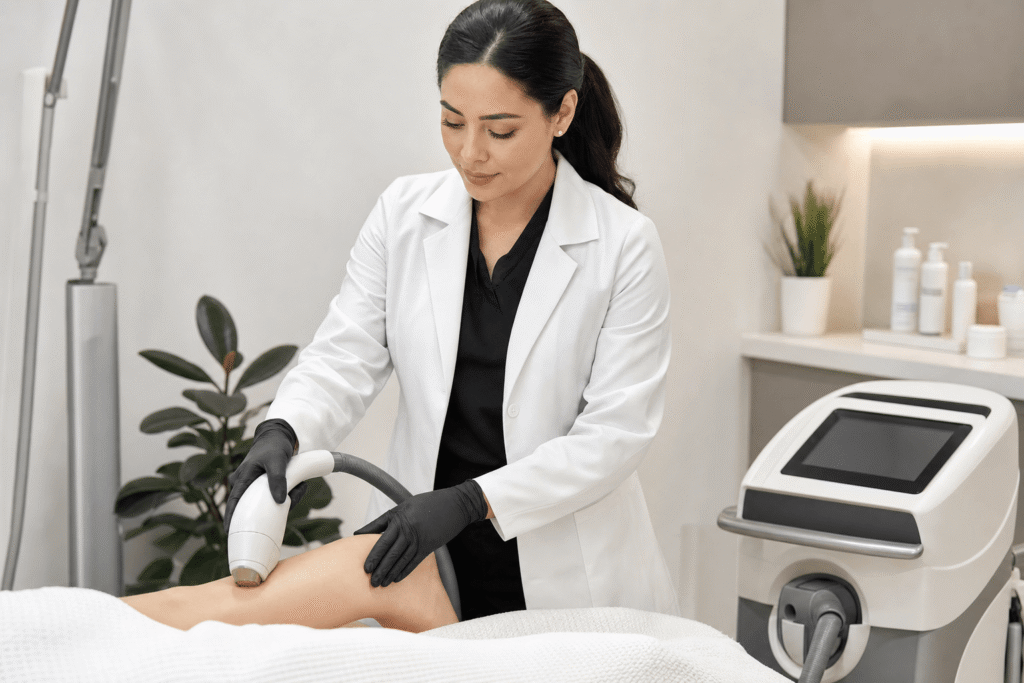
Before you book your first laser hair removal appointment, there are critical realities about the process that most people only discover after they’ve already started treatment. Understanding what laser hair removal actually involves can save you from disappointment, financial surprises, and unrealistic expectations.
This guide covers the eight most important things clients consistently wish they’d known before beginning treatment. You’ll learn why multiple sessions are non-negotiable, what the treatment actually feels like, how your individual biology determines your results, and what questions separate quality providers from risky ones.
Quick Answer
Laser hair removal requires 6-10 sessions over months, isn’t completely permanent, feels like rubber bands snapping your skin, costs significantly more than quoted single-session prices, and works best on dark hair with light skin. Results depend entirely on your hair color, skin tone, hormones, and choosing a qualified provider with proper equipment.
It’s Not a One-Time Solution: Why Multiple Sessions Are Required
The biggest misconception about laser hair removal is that you’ll walk out hair-free after one treatment. The reality? You’ll need anywhere from six to ten sessions spaced weeks apart.
This isn’t a marketing scheme. It’s basic biology. Your hair grows in three distinct phases: anagen (active growth), catagen (transitional), and telogen (resting). Laser energy only effectively destroys follicles during the anagen phase when melanin concentration is highest.
Here’s the problem: only 20-30% of your hair is in the anagen phase at any given time. The rest is dormant, completely unaffected by the laser.
At Samar Skin Care Clinic in North York, treatment intervals are calibrated based on the body area being treated. Facial hair cycles every 4-6 weeks, while leg hair takes 6-8 weeks. Samar schedules sessions accordingly rather than using a one-size-fits-all approach.
Key Takeaways
- Expect 6-10 sessions minimum because only 20-30% of hair is treatable at once
- Budget for the complete package cost, not single-session pricing
- Verify your provider customizes laser settings for your specific skin type
- Plan treatment timing around hair growth cycles, not calendar convenience
- Understand hormonal factors may require ongoing maintenance sessions long-term
Laser Hair Removal Isn’t Completely Permanent
The term “permanent hair removal” is technically misleading. That’s why FDA-approved devices are labeled for “permanent hair reduction,” not complete elimination.
After completing your initial treatment series, most clients experience an 80-95% reduction in hair growth. The remaining 5-20% might be finer and lighter, but it’s still there. And dormant follicles can reactivate years later due to hormonal shifts.
Pregnancy, menopause, PCOS, thyroid disorders, and certain medications can trigger new hair growth in previously treated areas. These aren’t treatment failures. They’re your endocrine system overriding the follicle damage.
Maintenance sessions become reality for many clients. According to treatment data, approximately 60-70% of clients need touch-ups within 2-3 years after completing their initial series. Some need a touch-up once a year. Others go three to five years before seeing enough regrowth to warrant retreatment.
During consultations in North York, Samar maps out realistic maintenance expectations based on each client’s hormonal profile and treatment area. Facial and bikini zones typically need touch-ups every 1-2 years due to higher androgen sensitivity in those follicles.
Results Depend Heavily on Your Individual Factors
Not everyone is an ideal candidate for laser hair removal, and your results will vary dramatically based on factors you can’t change: your natural hair color, skin tone, and hormone levels.
How Hair Color and Skin Type Affect Success
Laser hair removal works by targeting melanin, the pigment that gives hair its color. High contrast between your skin tone and hair color produces the best results.
Dark, coarse hair on light skin? You’re the ideal candidate. Blonde, red, or gray hair contains little to no melanin. Standard lasers struggle to target these follicles effectively.
Dark skin presents a different challenge. The melanin in your skin competes with follicle melanin for laser energy. If settings aren’t properly calibrated, you risk burns or hyperpigmentation.
The Fitzpatrick scale classifies skin types from I (very fair) to VI (very dark). Types I-III generally tolerate most laser types well. Types IV-VI require specific laser wavelengths, typically Nd:YAG lasers that penetrate deeper while bypassing surface melanin.
Self-Assessment: Evaluating Your Candidacy
Before booking, honestly assess your hair and skin characteristics. Look at your hair in natural light. Is it dark brown or black? You’ll likely see excellent results. Is it light brown, blonde, red, or gray? Your results will be limited regardless of which provider you choose.
Check your Fitzpatrick skin type. Types I-III can use most laser types safely. Types IV-VI need providers with Nd:YAG lasers specifically designed for darker skin tones.
Consider your hormonal health. Do you have PCOS, thyroid conditions, or take hormone-affecting medications? These factors mean you’ll likely need ongoing maintenance treatments even after initial success.
Evaluate your treatment areas. Body areas with higher androgen receptor density (face, bikini line, abdomen) respond well initially but may need more frequent touch-ups than arms or legs.
At Samar Skin Care Clinic, Samar calibrates laser wavelength, pulse duration, and fluence based on each client’s Fitzpatrick classification, a protocol refined through CNTAA training and hundreds of treatments across diverse skin tones.
The Real Timeline: What to Expect Week-by-Week Between Sessions
Instagram before-and-after photos make laser hair removal look instantaneous. The reality involves a weeks-long process of shedding, regrowth, and gradual reduction.
| Timeline Post-Treatment | What’s Happening | What You’ll Notice |
|---|---|---|
| Days 1-4 | Follicle damage begins | No visible change, possible mild redness |
| Days 5-14 | Shedding phase starts | Hair appears to grow but falls out easily when rubbed |
| Weeks 3-5 | Smooth period | Minimal to no visible hair growth |
| Weeks 6-8 | Next growth cycle begins | New hair emerges from untreated follicles |
Days 5-14 bring the shedding phase. Treated hairs push out as damaged roots release their grip. This looks like growth, but it’s actually elimination. You can speed this by gently exfoliating. The hair will slide out effortlessly.
Weeks 3-5 typically bring smooth, hair-free skin. Weeks 6-8 bring visible regrowth from the next wave of follicles entering anagen phase. This isn’t failure, it’s expected biology. By sessions 4-6, regrowth periods become noticeably sparser.
Ready to get started?
Book a consultation with Samar to discuss your skin concerns and find the right treatment plan for you.
What Treatment Actually Feels Like and How to Manage Discomfort
Most people describe the sensation as a rubber band snapping against your skin repeatedly. Your bikini line, underarms, and upper lip are far more sensitive than your legs or arms because of higher nerve density.
The pain is sharp but brief. Each pulse lasts a fraction of a second. But when you’re receiving hundreds of pulses across a treatment area, that brief discomfort adds up.
Modern laser systems include cooling mechanisms that significantly reduce discomfort. Topical numbing cream applied 30-45 minutes before treatment helps sensitive areas. Taking ibuprofen 30 minutes before your session reduces inflammation and sensitivity.
After treatment, most areas feel like mild sunburn for a few hours. Ice packs and aloe vera gel provide relief. Avoid hot showers, exercise that causes sweating, and tight clothing for 24-48 hours.
For a detailed breakdown of pain levels by treatment area and specific strategies to minimize discomfort, see our comprehensive pain level guide.
The Total Investment: Understanding Costs Beyond the Price Tag
That advertised price you saw? It’s almost certainly for a single session on one small area. The total cost of completing laser hair removal is substantially higher than most people expect.
Single-session pricing is misleading because you’ll need 6-10 sessions minimum. A small area like the upper lip might run $75-150 per session in Toronto. Multiply it by eight sessions and you’re looking at $600-1,200 for an area that takes 60 seconds to treat.
| Treatment Area | Per-Session Range (Toronto) | Total 8-Session Package Estimate |
|---|---|---|
| Upper Lip | $75-150 | $600-1,200 |
| Underarms | $100-200 | $800-1,600 |
| Brazilian Bikini | $150-300 | $1,200-2,400 |
| Full Legs | $300-500 | $2,400-4,000 |
| Full Body | $600-1,000 | $4,800-8,000 |
Hidden costs include maintenance touch-ups. If you need annual touch-ups indefinitely, add another $100-500 per year depending on how many areas you’re maintaining.
Compare this to lifetime waxing costs of $50-100 every 4-6 weeks. Over 20 years, that’s $13,000-26,000 for a single area. Suddenly laser hair removal looks economical despite the high upfront cost. Get accurate total package pricing upfront, not just per-session rates.
How to Know If You’re a Good Candidate Before Booking
Not everyone should get laser hair removal. Some people won’t get good results because of their hair or skin type. Others face medical contraindications that make treatment unsafe.
Ideal candidates have dark, coarse hair and light skin. This combination allows for aggressive treatment settings with minimal burn risk.
You’re a less-ideal candidate if you have blonde, red, gray, or very fine hair. Some light hair might respond, but expect slower progress and less dramatic results.
Very dark skin (Fitzpatrick types V-VI) requires specific laser types, typically Nd:YAG wavelengths, and more conservative energy settings. Not all clinics have appropriate equipment for dark skin.
Certain medical conditions disqualify you entirely. Active skin infections, keloid scarring tendency, and photosensitivity disorders make laser treatment unsafe. Isotretinoin (Accutane) makes your skin extremely photosensitive. You need to be off it for at least six months before laser treatment.
Pregnant women should postpone treatment. Not because laser damages the fetus, but because pregnancy hormones can trigger unpredictable hair growth patterns that make treatment results temporary.
During consultations at Samar Skin Care Clinic, Samar performs detailed assessments including Fitzpatrick skin type classification, hair characteristics examination, medical history review, and current medication analysis before determining candidacy.
Choosing the Right Provider: Questions to Ask and Red Flags to Watch For
Your results depend more on who operates the laser than on which laser they’re using. An experienced practitioner with an older machine will outperform an inexperienced operator with the latest technology every time.
Essential Questions to Ask During Your Consultation
Start by verifying credentials. In Ontario, laser hair removal must be performed by or under the supervision of qualified medical professionals. Ask about their certification specifically for laser treatments, not just their general license.
Ask what laser technology they use. IPL (Intense Pulsed Light) devices are cheaper and less effective than true lasers. True laser systems include Alexandrite (best for light skin), Diode (versatile for multiple skin types), and Nd:YAG (safest for dark skin). A quality clinic has multiple laser types to accommodate different skin tones safely.
Ask about patch testing. Reputable providers should offer to test a small area at your consultation appointment to assess your skin’s reaction before committing to a full treatment.
Question their pain management options. Do they use cooling systems? Can they provide numbing cream? Are they willing to adjust settings if you’re finding treatment intolerable?
Ask about their complication management protocol. What happens if you develop burns, hyperpigmentation, or scarring? Is follow-up care included in your package price?
Red Flags That Signal You Should Walk Away
Clinics that claim one laser works perfectly for everyone are lying. Different skin types need different wavelengths and settings. A one-size-fits-all approach means they’re either lying or undertreating darker skin tones to avoid burns.
Pressure to buy large packages immediately is a red flag. Quality providers want you to try 1-2 sessions before committing to expensive packages.
Unrealistic promises mean walk away. Anyone claiming 100% permanent removal, guaranteed results, or treatment in fewer than five sessions either doesn’t understand hair growth biology or is deliberately misleading you.
Inability to explain their approach means insufficient training. Ask them to explain how they’ll adjust settings for your specific skin type. If they can’t articulate a clear, individualized treatment plan, they lack the expertise for safe treatment.
Green Flags That Indicate a Quality Provider
Look for providers with specialized laser training beyond basic aesthetician credentials. Samar is a Licensed Medical Aesthetician who graduated from CNTAA in 2020 and holds more than 10 specialized certifications in laser technology and advanced skin treatments.
Quality providers offer comprehensive consultations that include detailed skin assessments, medical history reviews, realistic timeline discussions, and transparent pricing for complete treatment packages rather than just single-session rates.
They should be willing to show you their equipment, explain which laser type they’ll use for your skin tone, and demonstrate cooling mechanisms.
At Samar Skin Care Clinic, located at 5409 Yonge St, Unit 210 in North York, consultations include honest assessments and individualized treatment plans based on your specific hair type, skin tone, and hormonal profile.
For specific guidance on timing your preparation correctly to maximize each session’s effectiveness, read our complete pre-treatment preparation guide.
Frequently Asked Questions
How many laser hair removal sessions will I actually need?
Most people need 6-10 sessions spaced 4-8 weeks apart depending on the treatment area. Only 20-30% of follicles are in the active growth phase at any time, which is why multiple sessions are required to target all follicles as they cycle through growth phases.
Is laser hair removal truly permanent or will hair eventually grow back?
Laser provides permanent hair reduction, not complete removal. Most clients see 80-95% reduction after completing their series. Hormonal changes from pregnancy, menopause, PCOS, or medications can reactivate dormant follicles years later. About 60-70% of clients need maintenance touch-ups every 1-3 years.
How painful is laser hair removal and what does it feel like?
Most people describe it as a rubber band snapping against skin repeatedly. Pain varies by area, with bikini line, underarms, and upper lip being most sensitive. Modern lasers include cooling mechanisms that reduce discomfort. Topical numbing cream and ibuprofen help minimize pain.
What should I avoid before and after each laser hair removal session?
Before treatment, avoid sun exposure and tanning for 4-6 weeks. Shave 24 hours before but avoid waxing or plucking for 4-6 weeks prior. Stop retinoids 3-5 days before. After treatment, avoid hot showers, saunas, pools, and sweaty exercise for 24-48 hours. Wear SPF 30+ sunscreen daily on treated areas for at least 2 weeks.
How much does a complete laser hair removal treatment plan cost?
Complete packages in Toronto range from $600-1,200 for upper lip, $800-1,600 for underarms, $1,200-2,400 for Brazilian bikini, $2,400-4,000 for full legs, and $4,800-8,000 for full body (based on 8 sessions). Add $100-500 annually for potential maintenance touch-ups.
Making an Informed Decision About Your Treatment
Understanding these realities before starting laser hair removal transforms your experience from potentially frustrating to satisfyingly predictable. You’ll know why you need multiple sessions, what timeline to expect, how your individual characteristics affect results, and what separates quality providers from risky ones.
Samar brings Licensed Medical Aesthetician expertise and more than 10 specialized certifications to every consultation at Samar Skin Care Clinic, ensuring you receive honest assessments, individualized treatment plans, and realistic timelines based on your specific hair type, skin tone, and hormonal profile.
Ready to start your laser hair removal journey with complete transparency about what to expect? Book a consultation at Samar Skin Care Clinic in North York to discuss your specific concerns, assess your candidacy, and develop a personalized treatment plan. Call (647) 764-8424 or visit the clinic at 5409 Yonge St, Unit 210, North York to get started.
