
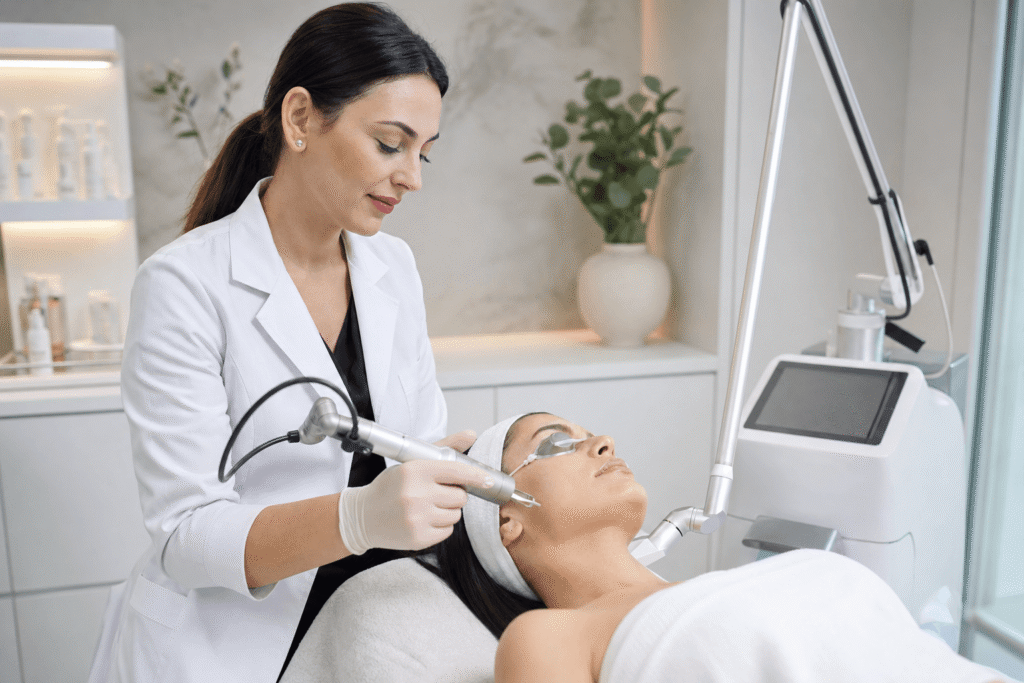
Acne scars can persist long after breakouts clear, affecting skin texture and confidence. Laser treatment for acne scars uses targeted light energy to resurface damaged skin and stimulate collagen production, gradually smoothing depressions and improving overall skin appearance. This comprehensive guide explains how laser treatments work, which types address different scar patterns, what the procedure feels like, recovery expectations, and costs specific to the Toronto area.
If you’re researching whether laser treatment is right for your scarring, you’ll find detailed information on how different laser technologies target atrophic scars, the differences between ablative and non-ablative options, and how treatment protocols adjust for various skin tones to prevent complications like post-inflammatory hyperpigmentation.
Quick Answer
Laser treatment removes acne scars by using concentrated light energy to ablate damaged tissue and stimulate deep collagen remodeling. Most clients need 3-5 sessions spaced 4-8 weeks apart, with gradual improvement visible over 3-6 months as new collagen rebuilds skin structure.
How Laser Treatment Works to Remove Acne Scars
Laser acne scar treatment relies on controlled thermal injury to trigger your skin’s natural healing response. When laser energy penetrates the dermis, it creates thousands of microscopic treatment zones that remove damaged tissue and stimulate fibroblasts to produce new collagen. This process, called collagen remodeling, gradually fills depressed scars from beneath the surface.
Different wavelengths target specific depths and chromophores in your skin. CO2 lasers emit 10,600nm wavelengths that water molecules in tissue absorb intensely, making them highly effective for ablative resurfacing. Erbium YAG lasers use 2,940nm wavelengths for more superficial ablation with less surrounding thermal damage. Non-ablative lasers like Nd:YAG work at 1,064nm to heat deeper tissue without removing the surface layer.
The depth and pattern of laser energy delivery determine treatment intensity. Fractionated lasers create columns of injury surrounded by untouched skin, allowing faster healing than fully ablative treatments that remove entire layers. At Samar Skin Care Clinic in North York, Samar calibrates laser fluence, pulse duration, and density based on scar morphology and Fitzpatrick skin type, adjusting parameters to maximize collagen stimulation while minimizing hyperpigmentation risk in darker skin tones.
Key Takeaways
- Choose ablative lasers for deep scars, non-ablative for mild texture issues
- Expect 3-5 treatment sessions spaced 4-8 weeks apart for optimal results
- Budget $500-$1,500 per session in Toronto depending on treatment area size
- Avoid sun exposure and active skincare ingredients during entire recovery period
- Verify your provider adjusts laser settings specifically for your skin type
Types of Laser Treatments for Acne Scars
Understanding the spectrum of laser options helps you match treatment intensity to your specific scarring pattern and tolerance for downtime. Each laser category offers distinct advantages and limitations.
Ablative Laser Resurfacing (CO2 and Erbium YAG)
Ablative lasers physically vaporize the epidermis and upper dermis, removing layers of scarred tissue to reveal smoother skin underneath. CO2 laser resurfacing remains the gold standard for severe acne scarring because it penetrates deeply enough to remodel significant tissue damage. The treatment creates controlled wounds that heal over 10-14 days, with continued collagen production for months afterward.
Erbium YAG lasers offer a gentler ablative option with more precise tissue removal and less surrounding thermal damage. The main consideration with ablative treatments is balancing results against recovery time. One aggressive CO2 session may produce more improvement than three non-ablative treatments, but requires nearly two weeks of social downtime and carries higher risks of prolonged erythema and hyperpigmentation, especially in Fitzpatrick types IV-VI.
Non-Ablative and Fractionated Laser Treatment
Non-ablative lasers like Nd:YAG heat the dermis without damaging the surface, stimulating collagen production through thermal injury alone. These treatments involve minimal downtime, usually just temporary redness for 24-48 hours, making them popular for patients with active lifestyles or darker skin tones where post-inflammatory hyperpigmentation is a concern.
Fractionated laser technology represents a middle ground. Fraxel and similar devices deliver ablative or non-ablative energy in a fractional pattern, treating only 20-40% of skin surface per session while leaving surrounding tissue intact to accelerate healing. This approach allows moderately deep penetration with recovery times of 3-5 days rather than the full two weeks required for traditional ablative resurfacing. While a single aggressive CO2 session might produce 50-70% improvement in scar appearance, fractionated treatments typically require 3-5 sessions to achieve comparable results.
For clients with Fitzpatrick skin types IV-VI, we often start with test spots using conservative settings to assess healing response before treating larger areas. This prevents unexpected hyperpigmentation that can be more difficult to treat than the original scarring.
What to Expect During Laser Acne Scar Treatment
The treatment experience varies significantly based on laser type, but understanding each phase helps you prepare mentally and physically for the procedure.
Pre-Treatment Preparation and Consultation
A thorough consultation identifies contraindications and sets realistic expectations. Your provider should assess scar types, skin tone, medical history, and current skincare routine. Active skin infections, recent isotretinoin use (typically within 6-12 months), and certain autoimmune conditions may require postponing treatment.
Most protocols require 2-4 weeks of pre-treatment preparation. This typically includes daily broad-spectrum SPF 30+ sunscreen, discontinuing retinoids and other active ingredients 5-7 days before treatment, and sometimes starting a hydroquinone regimen to reduce post-treatment hyperpigmentation risk in darker skin types. Some practitioners prescribe prophylactic antiviral medication if you have a history of cold sores, since laser treatment can trigger herpes simplex outbreaks.
Pain Management and What the Procedure Feels Like
Pain tolerance varies dramatically between individuals and treatment types. Non-ablative treatments often feel like repeated rubber band snaps with warmth that builds as the session progresses. Most people tolerate these with topical anesthetic cream applied 30-45 minutes before treatment.
Ablative treatments create more intense discomfort. Even with topical anesthetics, CO2 laser resurfacing produces a burning sensation. For full-face ablative treatments, some practitioners offer oral anxiolytics or coordinate with an anesthesiologist for IV sedation. A typical full-face fractionated treatment takes 20-30 minutes, while spot treatments for isolated scars might require only 5-10 minutes. Immediately afterward, your skin feels like a severe sunburn with tight, hot sensations that peak within the first few hours.
Ready to get started?
Book a consultation with Samar to discuss your skin concerns and find the right treatment plan for you.
Recovery Timeline and Post-Treatment Care
Understanding the healing process helps you plan appropriately and avoid complications that could compromise results. Recovery varies significantly between ablative and non-ablative approaches.
Days 1-7: Immediate Recovery and Downtime
Non-ablative laser treatments produce the easiest recovery. You’ll experience redness and mild swelling for 24-48 hours, similar to a moderate sunburn. Makeup application is usually possible after 24 hours, and most people return to work the next day.
Fractionated ablative treatments create more visible healing. Days 1-3 involve significant redness, swelling, and a sandpaper texture as treated columns begin forming micro-crusts. Your skin weeps clear fluid and feels tight. You’ll apply occlusive ointments every few hours to maintain moisture and prevent crusting. By days 4-5, the micro-crusts slough off, revealing pink, sensitive new skin underneath. Most people can return to work with mineral makeup by day 5-7.
Fully ablative CO2 treatments require the longest recovery. The first 48 hours involve substantial swelling. Skin weeps continuously and requires frequent gentle cleansing and thick ointment application. Days 3-7 bring intense peeling as the entire treated surface sheds in sheets. Social downtime typically extends 10-14 days, with persistent pinkness lasting 4-8 weeks or longer.
| Treatment Type | Initial Downtime | Makeup Application | Full Recovery |
|---|---|---|---|
| Non-Ablative | 0-2 days | 24-48 hours | 3-5 days |
| Fractionated | 3-5 days | 5-7 days | 7-14 days |
| Fully Ablative CO2 | 10-14 days | 10-14 days | 4-8 weeks |
Week-by-Week Results and Skincare Protocol
Visible improvement from laser acne scar treatment develops gradually over months. The initial result you see immediately after healing is actually only 20-30% of final improvement. True collagen remodeling continues for 3-6 months post-treatment, with texture continuing to refine throughout this period.
Week 1-2: Use gentle, fragrance-free cleansers and thick occlusive moisturizers or healing ointments. No active ingredients, no retinoids, no acids. Just protection and moisture. Strict sun avoidance is non-negotiable since newly healed skin has minimal melanin protection. Apply broad-spectrum SPF 50+ every two hours during any daylight exposure. Recommended products include CeraVe Healing Ointment, La Roche-Posay Cicaplast Baume B5, and Vanicream Gentle Facial Cleanser.
Week 3-6: Gradually reintroduce regular skincare. Start with gentle moisturizers containing ceramides and hyaluronic acid like CeraVe Moisturizing Cream or Neutrogena Hydro Boost. After week 4, you can typically resume vitamin C serums such as SkinCeuticals C E Ferulic or Timeless Vitamin C Serum if no irritation occurs. Most providers recommend waiting 6-8 weeks before restarting retinoids or chemical exfoliants.
Month 2-6: Continue improvement develops even without additional treatments. Collagen production peaks around 3-4 months post-treatment. This is why session spacing of 6-8 weeks makes sense; treating again before collagen fully develops doesn’t maximize each session’s potential. By month 6, you can assess final results from that treatment series.
We photograph clients in identical lighting before each session and at 3-month follow-ups. Acne scar improvement is so gradual that you often won’t notice the change day-to-day, but side-by-side photos reveal significant texture refinement that builds across the treatment series.
Cost of Laser Treatment for Acne Scars in Toronto
Laser acne scar treatment represents a significant investment, with costs varying based on treatment type, area size, and provider expertise. Understanding pricing structure helps you budget appropriately and evaluate provider quotes.
In Toronto and the North York area, expect to pay $500-$1,500 per session for professional laser acne scar treatment. Non-ablative treatments typically fall on the lower end of this range ($500-$800), while fractionated ablative treatments cost $800-$1,200 per session. Fully ablative CO2 resurfacing commands premium pricing of $1,200-$2,500 per session due to its intensity and the skill required to perform it safely.
Treatment area significantly impacts cost. Spot treatments targeting isolated cheek scars might cost $400-$700, while full-face resurfacing ranges from $1,200-$2,500 per session. Some clinics charge by density or number of passes rather than flat per-session fees, particularly for fractionated treatments where treatment intensity varies.
| Treatment Area | Cost Per Session (Toronto) | Typical Sessions Needed | Total Investment |
|---|---|---|---|
| Targeted spots (cheeks) | $400-$700 | 3-4 sessions | $1,200-$2,800 |
| Mid-face region | $800-$1,200 | 3-5 sessions | $2,400-$6,000 |
| Full face | $1,200-$2,500 | 3-5 sessions | $3,600-$12,500 |
Several factors influence final treatment costs in Toronto. Provider credentials matter significantly, as medical doctors and experienced laser technicians working under physician supervision typically charge more than unqualified operators, but their expertise reduces complication risks. Newer fractional CO2 systems with advanced cooling mechanisms command higher per-session fees than older equipment. Darker skin tones requiring customized settings and test spots may involve additional consultation time, and deep or extensive scarring requiring higher energy settings or multiple passes increases treatment time and cost.
Package pricing can reduce per-session costs by 10-20% when you commit to a series upfront. However, some practitioners recommend starting with a single session to assess your healing response and satisfaction before committing to a package.
Additional costs to factor include pre-treatment skincare products (hydroquinone, gentle cleansers, healing ointments), post-treatment sunscreen and skincare, and potential time off work during recovery. For aggressive ablative treatments, you might spend $150-$300 on post-treatment care products beyond the procedure fee.
Medical insurance doesn’t cover cosmetic laser treatments, though some clinics offer payment plans or financing through third-party providers. At Samar Skin Care Clinic, transparent pricing is provided during your initial consultation after assessing your specific scarring pattern and developing a customized treatment plan.
Comparing Laser to Alternative Acne Scar Treatments
Laser treatment isn’t the only option for acne scars. Understanding how it compares to alternatives in results timeline and recovery helps you choose the right approach for your lifestyle and goals.
| Treatment | Visible Results Timeline | Sessions Needed | Recovery Time |
|---|---|---|---|
| Ablative Laser | 3-6 months | 1-3 sessions | 10-14 days per session |
| Fractionated Laser | 3-6 months | 3-5 sessions | 5-7 days per session |
| Microneedling | 4-6 months | 5-8 sessions | 2-3 days per session |
| Chemical Peels | 2-4 months | 4-6 sessions | 3-7 days per session |
| Subcision + Laser | 3-6 months | 2-4 combined sessions | 7-10 days per session |
Microneedling creates controlled injury through fine needles rather than thermal energy, stimulating collagen production with minimal downtime and lower hyperpigmentation risk. It’s particularly valuable for darker skin types or those unable to tolerate extended recovery. Week-by-week comparison shows microneedling produces gradual refinement that becomes noticeable around weeks 8-12, while laser treatments create more dramatic texture change within the first 6-8 weeks as new collagen fills depressions.
Chemical peels use acids to remove superficial layers and stimulate cell turnover. Medium-depth TCA peels show fastest initial improvement in skin tone and mild texture within 3-4 weeks, but plateau earlier than collagen-stimulating treatments. They work well for mild scarring and pigmentation issues but cannot address deeper rolling or boxcar scars as effectively as ablative lasers.
Subcision involves inserting a needle beneath depressed scars to release tethering fibrous bands, allowing the base to elevate. It’s highly effective for deep rolling scars, often combined with laser resurfacing for comprehensive results. Many practitioners now favor combination approaches where subcision releases deep tethering before laser treatments refine surface texture, achieving superior outcomes compared to either treatment alone.
Risks, Side Effects, and Who Is a Good Candidate
Laser acne scar treatment is generally safe when performed by qualified providers, but understanding potential complications helps you make an informed decision and recognize problems early if they occur.
Common temporary side effects include redness, swelling, and skin sensitivity. These are expected parts of the healing process and resolve within days to weeks depending on treatment intensity. Pinpoint bleeding during ablative treatments is normal, as is the bronzed appearance of healing micro-crusts.
Post-inflammatory hyperpigmentation is the most common significant complication, particularly in Fitzpatrick skin types III-VI. This darkening of treated areas results from melanocytes overproducing pigment in response to thermal injury. Risk increases with excessive laser energy, inadequate cooling, insufficient pre-treatment preparation, or sun exposure during healing. When it occurs, hyperpigmentation can take 6-12 months to fade with diligent treatment using hydroquinone, vitamin C, and strict sun protection.
Hypopigmentation, or permanent lightening of treated skin, is less common but more difficult to correct. It typically results from excessive tissue destruction that damages melanocytes permanently. This risk is higher with aggressive ablative settings or multiple closely-spaced treatments that don’t allow adequate healing between sessions.
Infection, though rare with proper aftercare, can occur during the healing period when skin barrier function is compromised. Bacterial infections require prompt antibiotic treatment, while herpes simplex reactivation needs antiviral therapy. This is why practitioners prescribe prophylactic antivirals for patients with cold sore history.
Scarring from laser treatment itself is extremely rare but catastrophic when it occurs. It results from excessive thermal injury, infection during healing, or inappropriate treatment in patients taking photosensitizing medications or with poor wound healing capacity.
Good Candidates for Laser Acne Scar Treatment
Ideal candidates typically have realistic expectations about gradual improvement rather than complete scar elimination, inactive acne without current inflammatory lesions (active acne should be controlled first), no recent isotretinoin use (most providers require 6-12 month waiting period), willingness to commit to strict sun protection during treatment and recovery, adequate healing capacity without autoimmune conditions that impair wound healing, understanding of downtime requirements and ability to plan around recovery, atrophic (depressed) scars rather than raised hypertrophic or keloid scars, and commitment to complete pre-treatment preparation protocols.
Poor candidates include those with active skin infections, unrealistic expectations of perfection, inability to avoid sun exposure, or conditions like active lupus or uncontrolled diabetes that impair healing. Patients currently using isotretinoin must wait 6-12 months after discontinuation before laser treatment due to impaired healing capacity.
For darker skin tones (Fitzpatrick types IV-VI), finding a provider experienced in adjusting parameters is essential. Samar’s training includes specific protocols for treating diverse skin types safely, including test spots, conservative initial settings, longer intervals between sessions, and aggressive pre-treatment preparation to reduce complication risks that can occur when practitioners simply use default settings regardless of patient melanin content.
Frequently Asked Questions About Laser Acne Scar Treatment
How does laser treatment work to remove acne scars?
Laser treatment uses concentrated light energy to remove damaged skin layers and stimulate collagen production in deeper tissue. The thermal energy triggers your body’s healing response, prompting fibroblasts to generate new collagen that gradually fills depressed scars from beneath the surface. Ablative lasers vaporize tissue layers for dramatic resurfacing, while non-ablative lasers heat the dermis without surface damage to stimulate gradual remodeling with minimal downtime.
How much does laser treatment for acne scars cost in Toronto?
Laser acne scar treatment in Toronto typically costs $500-$1,500 per session depending on treatment area size and laser type. Targeted spot treatments range from $400-$700, while full-face resurfacing costs $1,200-$2,500 per session. Most patients need 3-5 sessions for optimal results, bringing total investment to $1,500-$12,500 depending on scarring severity. Package pricing may reduce per-session costs by 10-20%.
How many laser treatment sessions are needed for acne scars?
Most patients require 3-5 laser treatment sessions spaced 4-8 weeks apart for significant acne scar improvement. Mild scarring may respond adequately to 2-3 sessions, while severe or deep scars often need 5-6 treatments. Aggressive ablative treatments require longer spacing (6-8 weeks) to allow complete collagen remodeling, while gentler non-ablative treatments can be performed every 4-6 weeks with cumulative improvement developing over 3-6 months.
What is the difference between ablative and non-ablative laser treatments?
Ablative lasers physically remove skin layers by vaporizing tissue, creating controlled wounds that heal with smoother texture over 10-14 days. Non-ablative lasers heat deeper tissue without damaging the surface, stimulating collagen production with only 1-2 days of redness. Ablative treatments show more improvement per session but carry higher risks of hyperpigmentation and prolonged recovery, while non-ablative options offer safer treatment for darker skin tones with minimal downtime but require more sessions.
How long is the recovery time after laser treatment for acne scars?
Recovery time varies by laser type. Non-ablative treatments require 1-2 days of mild redness with next-day return to normal activities. Fractionated ablative lasers need 5-7 days before makeup application and social activities. Fully ablative CO2 resurfacing demands 10-14 days of intensive wound care before returning to public activities, with persistent pinkness lasting 4-8 weeks. All treatments require strict sun protection during healing, and collagen remodeling continues improving texture for 3-6 months post-treatment.
Taking the Next Step Toward Smoother Skin
Laser treatment for acne scars offers genuine improvement for atrophic scarring when performed by qualified practitioners who understand how to adjust treatment parameters for different skin types and scar patterns. The combination of controlled tissue removal and collagen stimulation creates gradual texture refinement over months, with results that continue developing long after your final session.
If you’re considering laser treatment for your acne scars, Samar at Samar Skin Care Clinic brings specialized training in treating diverse skin types to every consultation. Located at 5409 Yonge St, Unit 210, North York, ON M2N 5R6, the clinic offers customized treatment protocols that match laser settings to your specific Fitzpatrick type and scarring pattern. Schedule your consultation today to discuss whether laser acne scar treatment aligns with your skin goals and lifestyle, or call (647) 764-8424 to speak with our team about preventing future acne alongside treating existing scars.
